Curiosity got the better of me in the end. I’ve had a Vargo Triad for a while now and used it on several bikepacking trips. A Whitebox stove is a variation on the same theme: an ultralight meths stove. I was intrigued to actually see if the Whitebox was better or not, so the only way to find out was to buy one and test it against the Triad.
The two units differ quite significantly in appearance and construction:
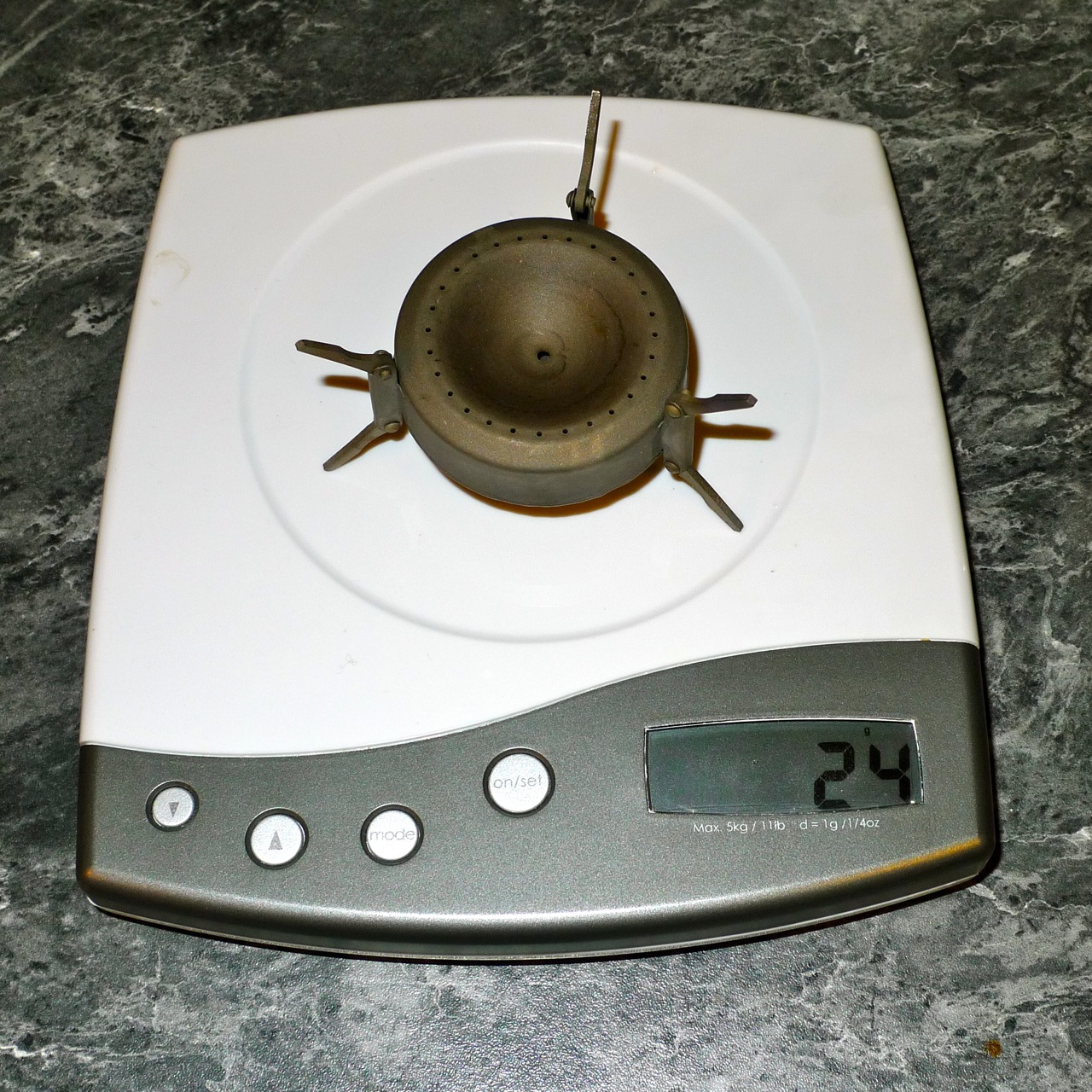
Vargo Triad: all titanium in construction, three fold out legs give it stability at the base and three fold out arms support a pan. The main part of the stove is round, with the upper inner part concave finishing in a small hole into which you pour the fuel. The outer part of the ring has 28 holes which form a ring of jets in an upward direction. The stove jets are 45mm in diameter and weighs 24 grams. The overall diameter of the pan support is 85mm.
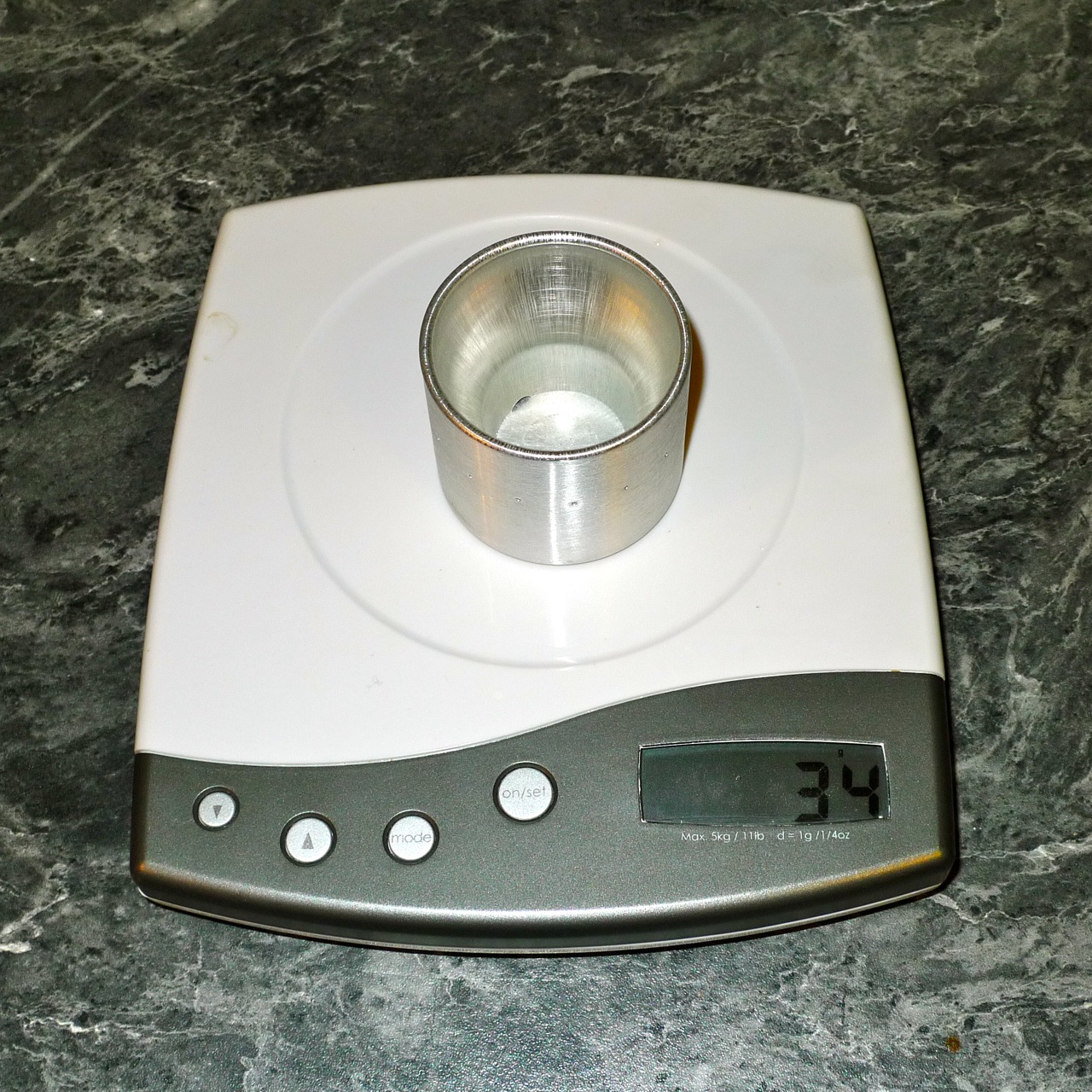
Whitebox Solo: all aluminium construction, it consists of a simple cylinder with a smaller tapered insert into which you pour the fuel. The base of the insert has two little holes that allow fuel into a gap between the inner and outer parts. Around the outer part of the stove are 15 jets that face outwards. The stove is 58mm diameter and weighs 34 grams.
The Test
I wanted to establish the boiling time for 450ml of water (the volume of my titanium mug) and two different pans: Tibetan Titanium 550ml and Snow Peak 1100ml. They measure 90mm and 110mm diameter respectively, which is an important part of the test, as you’ll see in a minute.
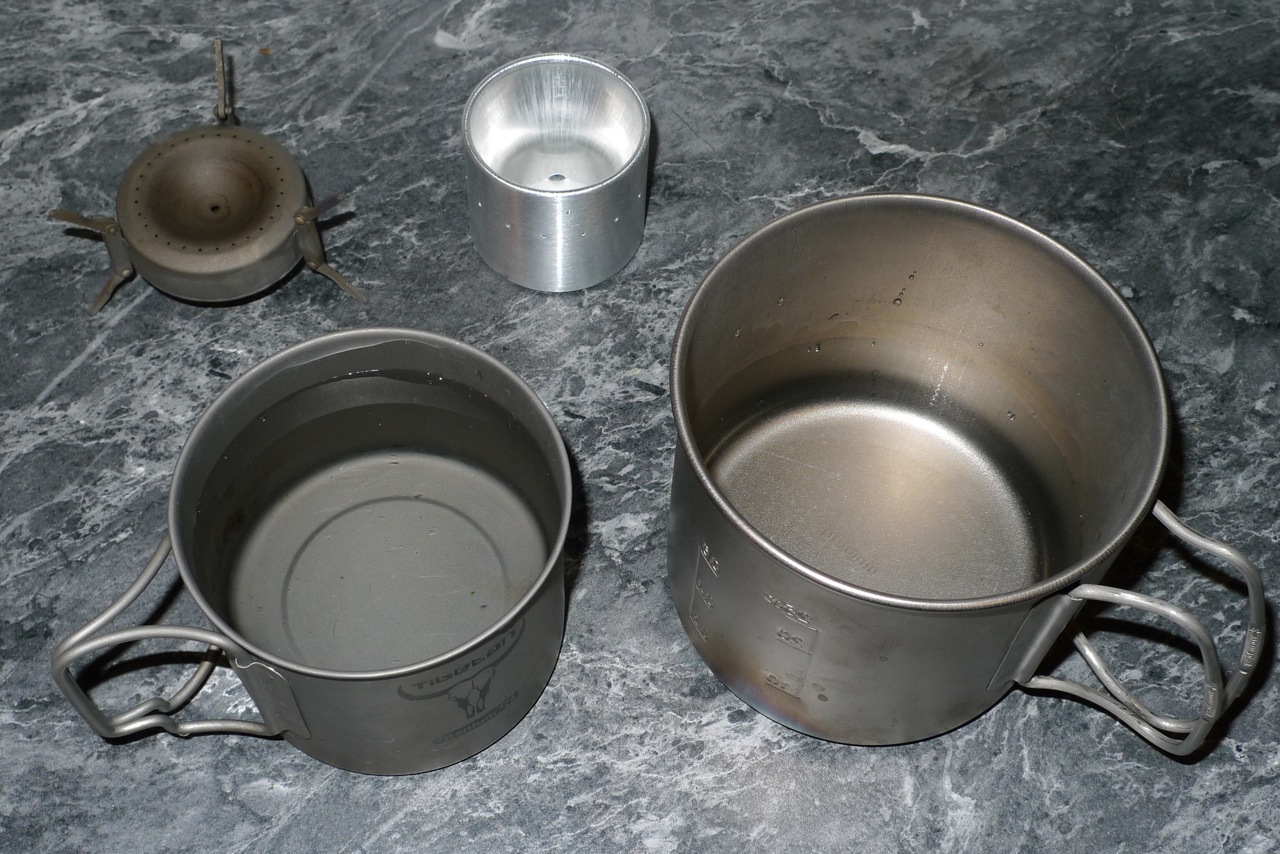
The test environment was my garage work bench and all four boil tests were run consecutively. I used the supplied Whitebox reflective wind shield for both stoves. The procedure was to fill the stove from empty to full and measure the weight of fuel. I wanted to see which stove worked bet with which diameter pan.
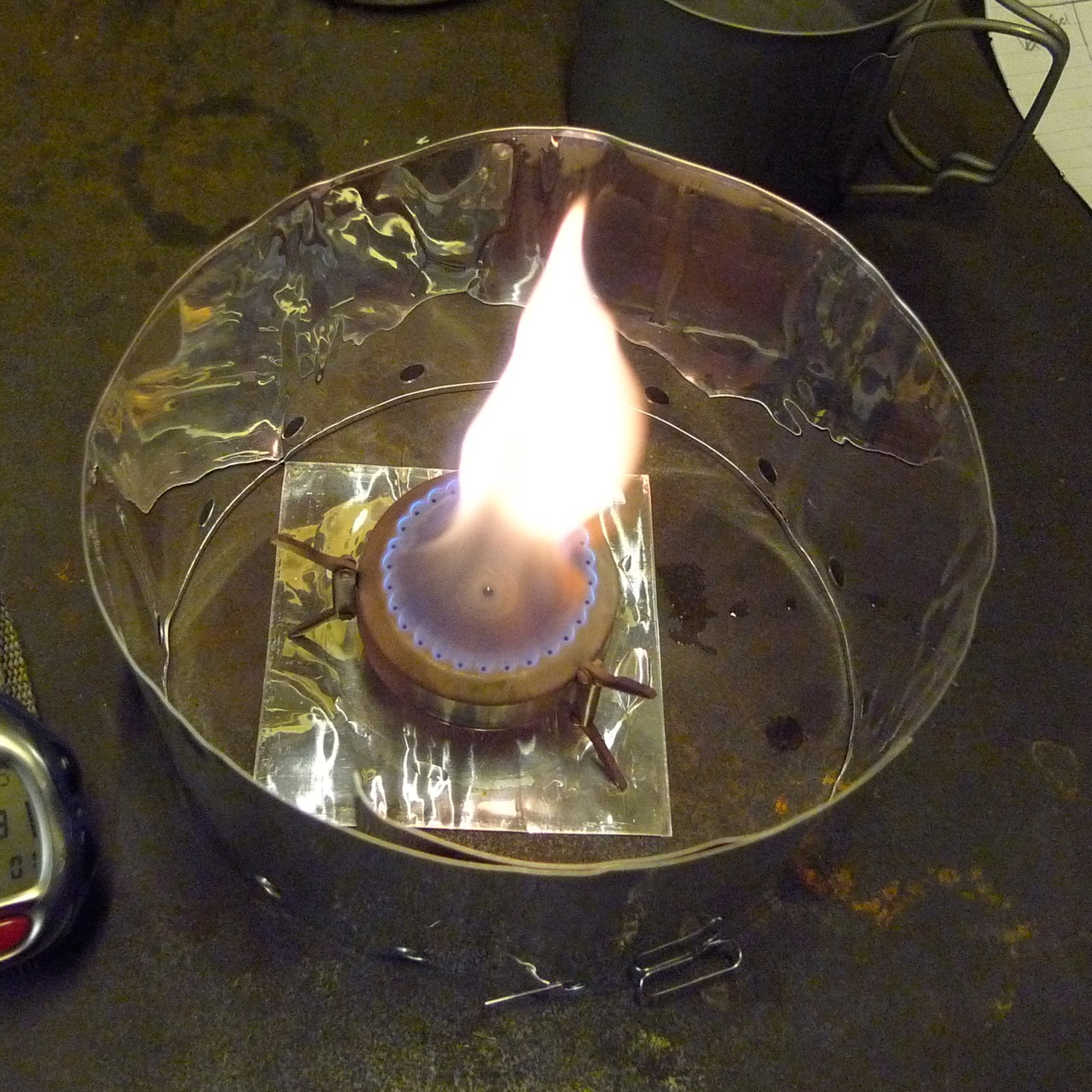
When you look at the two stoves lit, you’ll see that the jets of the Vargo Triad are orientated upward and the Whitebox are orientated outward.
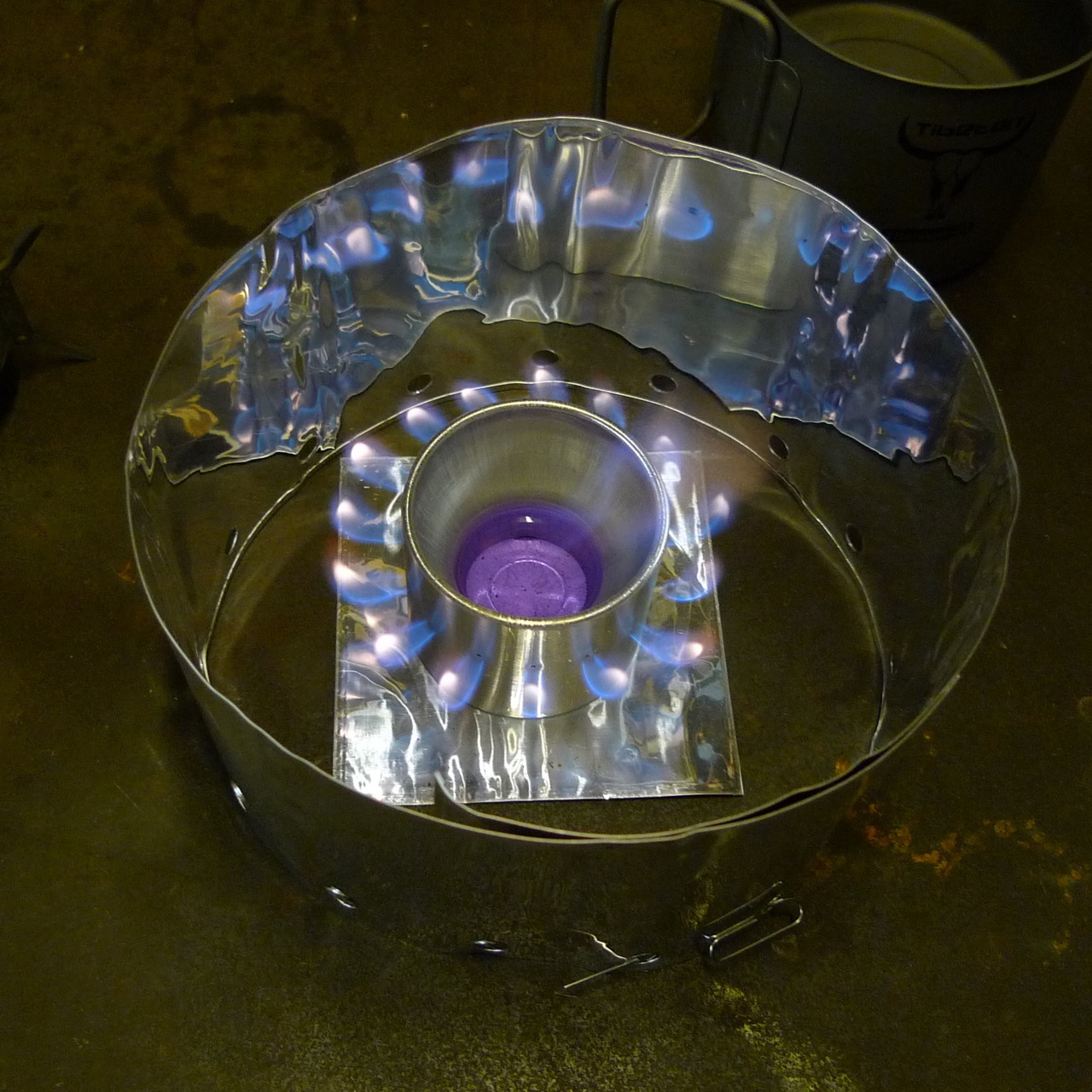
I lit the stove and timed it to the point that a steady flame emerged from all the jets. I placed the windshield around the stove put the pan on and began recording the boil time. The recorded times below are once the pan has achieved a rolling boil.
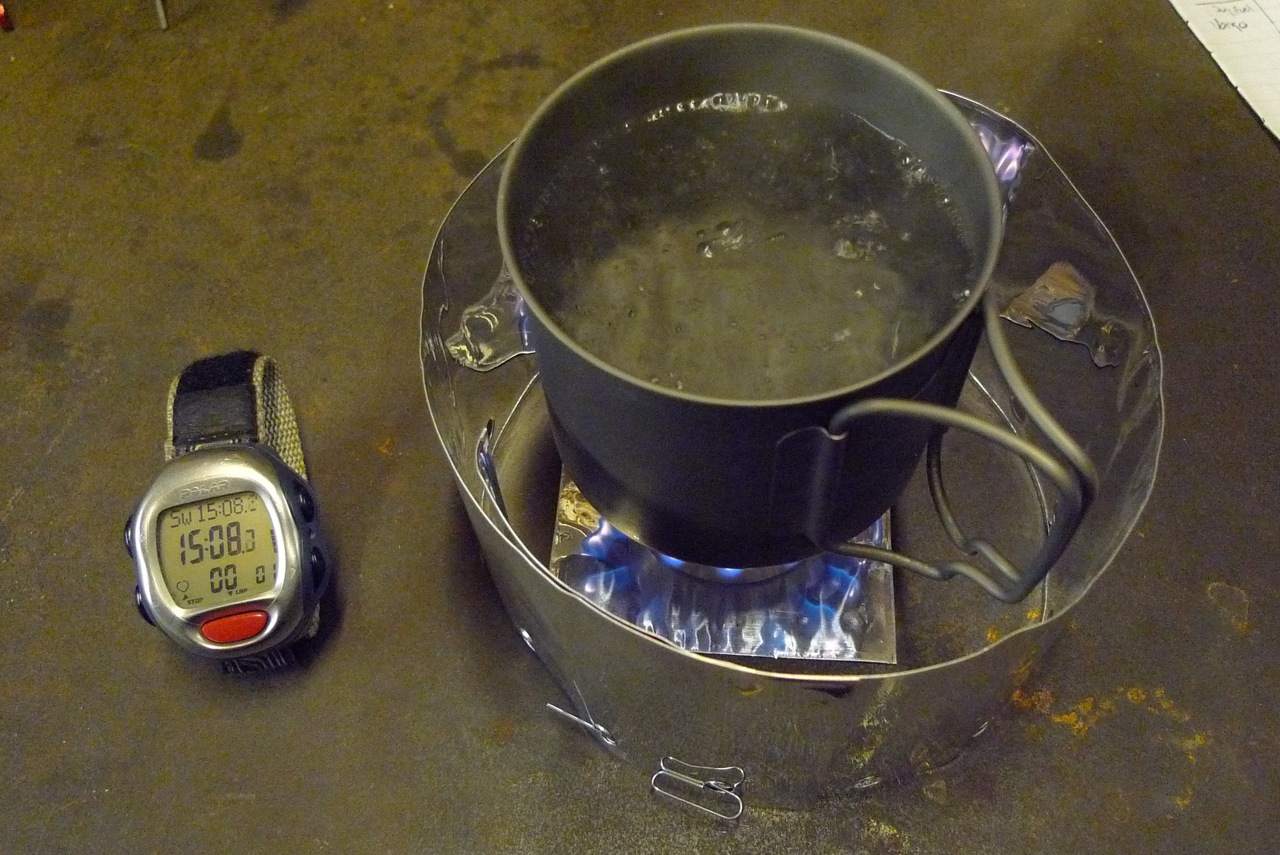
Readers should note that the tests were completed without a lid on the pan. This was mainly so I can see the water coming to the boil without having to remove a lid and for there to be variation between each scenario in doing so. Using a lid would of course reduce the boil time. Another point is that when in real world situation I would have accepted water as being boiling sufficient for noodles, coffee, smash or whatever I’d be cooking, a good couple of minutes before it got to a rolling boil. Thus, the total times achieved in the test are not the focus, but the difference between each stove for each of the pans.
Results
The Whitebox would hold 5 grams more fuel than the Triad, but the priming time of the Triad was 33 seconds quicker than the Whitebox. In the boil test, the results showed that the Triad was 15 seconds quicker to boil the water on the 90mm diameter pan than the Whitebox (45 seconds if the priming time is included). Conversely, the Whitebox was 1 minute 25 seconds quicker than the Vargo Triad with the 110mm diameter pan, but this time is reduced to only 52 seconds quicker when the longer priming time of the Whitebox is taken into account.
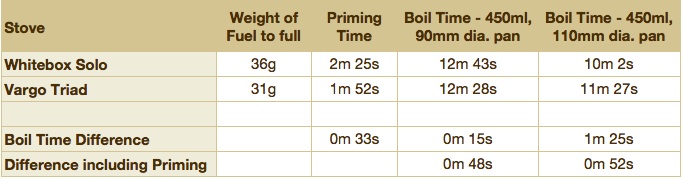
Given the orientation of the jets on each stove, these results are perhaps unsurprising, though the comparatively small difference is interesting and less than I expected. Though I didn’t measure the remaining volume of fuel, I would add that the Whitebox is virtually dry of fuel after each boil test, whereas the Triad still had enough fuel to be poured back into the fuel bottle on completion. Thus, it appears that the Vargo is a more efficient stove.
Conclusion
For small diameter pans of 90mm diameter (or less), the Vargo Triad would be the best stove to use, as this set up would be provide the lightest weight option: ligher stove, more efficient so less fuel required as well as a smaller and lighter pan.
I wouldn’t use the Whitebox with a pan less than 90mm diameter, and it appears more suited to pans of a larger diameter than that anyway. The increased heat generated from the outward jets of a Whitebox would yield shorter boil times, but at the expense of higher fuel consumption.


 Ian Barrington
an interesting experiment! I cant believe how small both of these stoves are…
The only meths burning stoves I used were Trangia which seem to be made of cast iron compared to these! I remember I used to mix a tiny bit of water with the meths to increase the burn time and reduce the amount of soot on the bottom of the pan. I think it reduced the heat of the flame though, which isn’t good considering the thickness of trangia pans (esp the non-stick ones).
Yeah, took me longer than I thought. Spent yesterday evening watching pots of water boil…
I haven’t tried adding the water – keep meaning to give that a go.
So which would you prefer to use out in the hills? Testing at home isn’t the same in my experience, I loved my jetboil, until a climbing trip where I wished to lauch it into the nearest crevasse!
Hi Paul: You’re quite right, and until I’ve given the Whitebox a proper test on my next trip it’d be unfair to comment. In a controlled environment though, the Vargo was easier to light/ extinguish and supported a pan better. The Whitebox was easier to add fuel to without spillage, and was more difficult to extinguish and therefore probably better in blowing conditions. I didn’t see how easy it was to pour fuel back out of the Whitebox because it was practically empty at the end of each test.
It’s good to hear some feedback, as I’ve been looking at both stoves, and based on online reviews each stove has it’s fans and limitations! I’m thinking the Whitebox looks like it may get a MSR Ti Kettle boiling faster, but ….
Wow, the whitebox can kick out some serious flames! Great stove :o)
I think you have very little alcohol stove experience if you think the triad is a great stove. Check out these stove reviews and note where the Vargo Triad is listed…
http://www.backpackinglight.com/cgi-bin/backpackinglight/reviews/category_display?cid=18&cat=Stoves%20%2D%20Alcohol
The point of the review was as much to illustrate the importance of pan diameter across two different stoves. I’m not saying its the best stove ever, but it works for me. There may be better ones out there, but I’ve just not tried them yet 🙂
A sample size of 1 with no science behind the review is hardly indicative of how good the Vargo is or isn’t. I thought Ian’s review was very good, perhaps you would care to share your vast experience with some of your scientific reviews?
Hi Ian,
Thanks for a great article. FYI, I would agree with your findings on the triad (I haven’t tried a whitebox) and I have found a similar, small but definite difference depending on pan used: not just diameter but also the material (titanium vs aluminium). Like you said though, using a lid makes a huge difference in boil times. However, one thing that rarely comes up in tests but makes a huge difference in the field is an effective wind shield. Maybe a further test would produce some interesting results?
One question: You mentioned about extinguishing the triad. Have you found an easy way of doing this? I usually end up just letting mine burn out, but know i shouldn’t really do this.
Any advice would be appreciated, thanks.
Pete
Hi Pete,
I made a windshield based on the Caldera Cone, specifically to fit with the Tibetan 550 pan on the Triad. Reduction in boil time with this with/without lid was quite significant (8m 54s vs 10m 47s). http://www.flickr.com/photos/15512491@N08/5577107064/ & http://www.flickr.com/photos/15512491@N08/5574809301/
I tend to extinguish the Triad simply with one strong blow down onto it. Hope that helps 🙂
Cheers,
Ian
Thanks for that Ian, will give it a try. Much appreciated.
Cheers,
Pete.