Trans Cambrian Way Double (Part 2)

Click here for Part 1

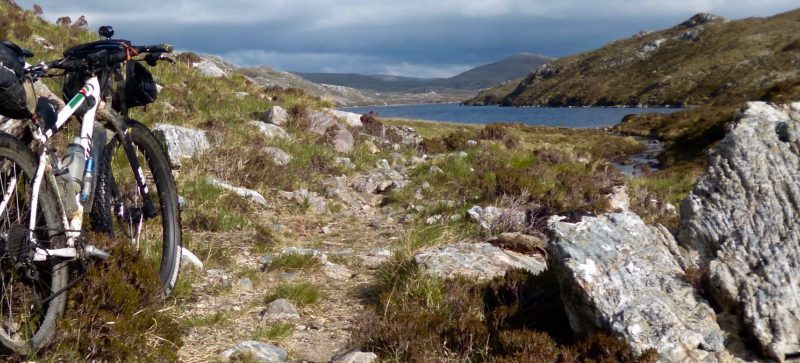
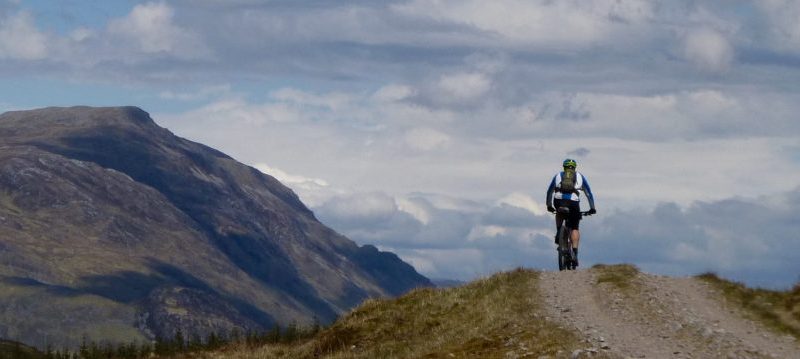
It’s probably worth just talking about the style of this ride. I’d chosen to ride totally self-supported. All my gear and food was either strapped to my bike or concealed in the back pockets of my riding jersey. I knew fairly well before setting out that I wouldn’t be able to do the whole ride without some rest, and so decided to pack a very lightweight bivy bag (Wasatch Bivvy – 105g), sleeping bag (PHD Minim 900 down bag – 363g). These were packed into a 2 litre drybag and strapped to the front of the bike in a custom Wildcat Gear Mountain Lion. The rest of my gear went into a Wildcat Gear frame bag, the majority of which was filled with food, but also a 3/4 length Thermarest NeoAir (which I admit was a bit of a luxury), a Gore Alp-X 2.0 jacket and some tools. The frame bag was cut around one 610ml bottle on the seat tube, which required me to keep a careful eye on my water intake and fill up whenever I saw the opportunity at a clear-running stream. So that was it. Everything neatly contained on my bike, and nothing on my back.

Up until now, I’d also been “flying under the radar”. I had a Spot tracker with me, but only Beth (my wife) knew where to look for progress updates. It wasn’t until a I sent out a few tweets at Dyfi Junction that I declared my intention to ride the double. But now the word was out, I was committed to getting to the job done.

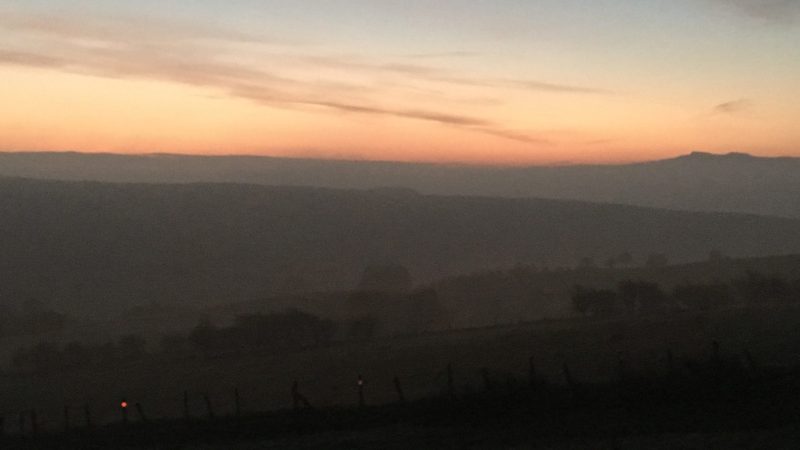
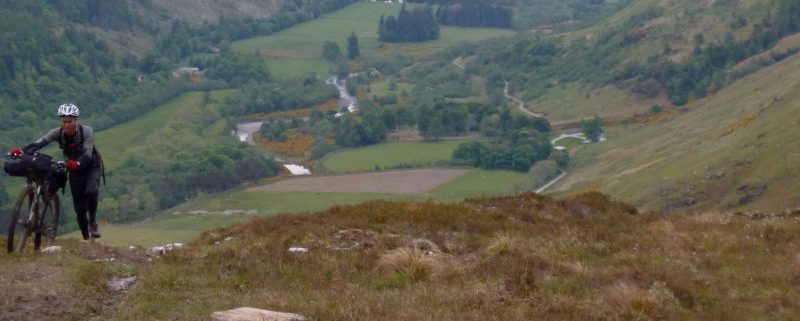
Every joyful descent leading down to the Dyfi Junction became a painful climb to regain the higher elevations – they’re not called the Cambrian Mountains for nothing. Glaspwll track was a steady slog on foot; its gradient too steep for my 32:19 ratio and my already well-traveled legs. Once at the top, the grassy terrace was even more beautiful in reverse, and with the low sun now casting a warm orange cast over the landscape. However, this was soon forgotten when I reached the bottom of Foel Fadian. Its intimidating steep flanks rose up steeply to a crisp darkening sky. The push turned to a slog, and I would occasionally stop and look back to where the sun had been, but it didn’t diminish the effort required to complete the ascent. By the time I reached the top, it was properly dark and the temperature beginning to drop.

At the bottom of Y Grug, I stopped to fill my bottle up, drop in a caffeine tablet and put my jacket on to fend off the cold air. I certainly needed it for the fast descent that soon followed into Staylittle. Hafren Forest became a bit of a blur – straight forward climbs now required significant effort to get up. I was certainly starting to feel the effects of tiredness and fatigue. The yawns started to come, and so at the next opportunity to fill up with water, I put in two caffeine tablets. The result reminded me of Red Bull but without the fizz. I scoffed some chocolate down too to hopefully give me a bit of a kick.

After crossing the A44, there is a long and punishing climb into the forest where Nant Rhys bothy lies. I wasn’t far now from my opportunity to put my head down for some sleep. The caffeine tablets seemed not to be making much difference, and I could feel me head nodding while riding. I get off and push some of the upward bits – it was probably safer. Eventually, the top came, and I rolled wearily down to the bothy. I arrived at 00:50 am, 19 hours 20 minutes since leaving Knighton, and with 226 km on the clock. That was pretty much two thirds distance, and I was fairly well spent.

In the bothy, I quickly unrolled and inflated my mat, unpacked my sleeping bag, ate some more food and dusted the mud off my legs before setting my alarm for 05:00 am and crawling inside my bag to go to sleep. It didn’t take long. Minutes, probably. Somewhat annoyingly, I was awoken at 03:00 am by the other two people in the bothy (walkers) getting their gear together to leave. Who, on earth, goes for a walk at three O’clock in the bloody morning?! I imagine they thought much the same when I came in just two hours before.

Now awake, but still tired, I was paying the price for the few grams I’d attempted to save on my sleeping bag as I lay there feeling the cold. I semi-dozed for about an hour, not quite able to haul myself back out of my sleeping bag and head into the cold and dark to finish the rest of the ride. Eventually though, when I thought I could discern the faintest beginning of a dawn through the windows, I got up. By the time I’d packed up my gear and got on the bike again it was 05:00 am, so at least I was still a little ahead of schedule.

Its amazing how much of an effect only two hours sleep can have when you’ve been awake for over 20 hours. The first hill was conquered with comparative ease, though I had a acute sense it wasn’t going to last. At the next available water point, I filled up my bottle, poured in some Torq recovery powder and had breakfast on the roll down to Cwmystwyth. Here the climbing started again in earnest. The enjoyable rocky descent though the woods from yesterday became another long push. The lanes and wild double track that followed were noticeably more wearing that the outward journey, but I had the benefit of a stronger tail wind. To my fortune, overnight, the wind had turned from north east to westerly. Perfect.

I stopped again at my lunchtime stop from the previous day at Teifi Pools, this time for second breakfast at 7.30 am, though I can’t honestly remember what I ate or for how long I was there. The Claerwen track that follows works well from west to east and I felt I made some good time on this section to arrive at the bottom of the dam about an hour later. The sodden and broken byway beyond the dam hadn’t improved overnight, and to make matters worse my slow brain and slowing reactions weren’t making line choice any easier.

Back in Rhayader, the town was just getting going, though by most peoples measure was probably still half asleep. Clive Powell had got his bikes outside the shop, but I didn’t see anyone. I filled up at the tap again, hoping this would be the last time before the finish. I calculated it would be about 4 hours back to Knighton. On the road out of town, I did my mental fly-through of the rest of the route. I could recount all the bits, so I thought, but such fantasies make little allowance for gradient, which was brought home to me at the huge road climb that followed the A483 road crossing up to Fron Top. The section that followed over Warren Hill appeared to be missing from my mental image and for a while I struggled to work out where I was and what would come up next.

Familiarity returned when I reached the edge of the Beacon Hill track. I finished the last of my peanuts, swallowed a gel and ate some more chocolate. This was it. One hour to the finish, and with 400 metres of elevation under my belt, this was surely going to be easy. Wrong. Oh, how my body ached. My underside of my right foot was sore, my wrists ached. My shoulders were tense and jarred over every rock and rut. My right hip felt a bit tight too, but it seemed OK at turning the pedals at least. As a bumped my way down the descents, trying as best I could to take the smooth lines, I felt like I had lost all finesse. I felt like a passenger on the bike unable to anticipate and respond in time for the next obstacle.

At last, Knucklas. Tarmac. Smooth. Joy of joys. Three miles and one climb lay between me and the finish. I dug as deep as I could on what would have been a modest gradient on any other day. I rolled into Knighton, swept through the car park and onto the station platform. I got out my phone and took a photo, much to the bemusement of the women sat further down the platform waiting for the next train. I hit the OK button on my Spot to send out a pre-prepared message for Twitter to say that the Trans Cambrian Way Double was complete, and a link to the Spot page that had cataloged my progress to Dyfi Junction and back.

Back at Knighton

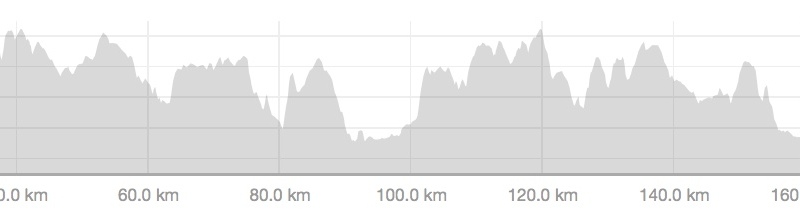
My time on the GPS said 14:03 pm, which meant I’d completed the ride in 32 hours and 33 minutes. Some 338 km of riding, and over 7,900 metres of ascent.

A very long way

I rang Beth to say I was finished, and within minutes of that, I got a text from Mark Goldie asking how it had gone (Mark holds the record for the TCW single). Soon after that messages came in via Twitter. The last 32 hours had been so solitary I was grateful of any sort of communication. I rode back to the car, changed and went into town or some food. Gradually the full sense of achievement dawned on me. As far as I know, no-one before me had ridden the Trans Cambrian Way Double as an Individual Time Trial, and even if (or when) the time gets beaten, I will always have been the first :)

Trans Cambrian Way Double (Part 1)

I roll down the high street in Knighton early on Saturday morning. A nearly full moon is beginning to set in the south west, and the first light of dawn is beginning to show in the other direction. I pull up at the railway station, place my bike under the sign and take a photo.  Its 5.30 am. There’s only one ride that starts here: the Trans Cambrian Way. And for the first time, possibly, it’ll also feature as the end of the ride. Here is my account of the Trans Cambrian Way Double.

Knighton

The sun finally breaks over the horizon as I make my way over Beacon Hill. Skylarks burst into song overhead, and lapwings fly up around me. Further up the track, a hare dashes across my path and then reappears a little further ahead running in the same direction. No race today I’m afraid, Mr Hare. I’m reminded of the hare and tortoise story. This ride isn’t about speed as such, its about getting my body and my bike to the finish. And for at least the next 12 hours, I’ll be riding away from the finish.

The trails are good; the grass is still short after a hard winter, and although the ground is damp in places it doesn’t drag too much. I pick my way around some boggy bits that look like they never dry out, and wherever I can take the cleanest and smoothest line to reduce the impact on my body. With Beacon Hill and Bwlch-y-sarnau behind me, I roll into Rhayader. I fill my water bottle up at the tap beside Clive Powell Cycles, grab a couple of things to eat from my bag and roll back out of town. I elect to push the fierce tarmac climb up to Gro Hill, before enjoying the fast grassy descent to the western end of Caban Coch Reservoir. The trail, such as it is, continues south of the river that issues from beneath the Claerwen Dam: a rock strewn, eroded and waterlogged byway that has suffered beneath the wheels of countless motorbikes and off-roaders. I do my best to pick a line among the rocks and keep my feet dry around the waterlogged bits.

Claerwen Reservoir comes into view and I embark on the 10 mile ride that weaves along the northern shore. I’m grateful of a modest tailwind on some parts but the track changes direction to such an extent I sometimes find myself facing the cool northerly wind head on. At Teifi Pools I stop for a proper break, fill my bottle up, lube the chain and enjoy a bit of food in the sunshine. I also needed some music. Whilst I’m normally content to listen to the sound of the world around me, it was getting a bit monotonous; neither silence or noise – just the constant sound of nothing in particular, and it was getting a bit wearing.

The route continues over the top to Cwmystwyth via a mix of wild double-track, tarmac and some rocky woodland descent.  Eventually I regained the tarmac leading up the valley. Any respite offered by the smooth and gentle gradient was entirely countered by a headwind.

Along the road, I caught up a youngish chap on a touring bike. He starts to tell me how he’s doing a big ride to prepare for a tour of the UK later in the year, and then he looks at my bike, and particularly the gears. Singlespeed wasn’t a concept he’d encountered previously, and not one he could easily relate to.

You’ve got no gears!

Blaenycwm to Llangurig passed largely without any incident. The only thing to note was that somewhere along this section marked one third distance for the route. Onward into Hafren, I started to get the feeling that the end of the first half was coming to an end. I’d spent a lot of time studying the maps, and although not entirely familiar with every bit of trail on the latter part of the route, I could do a mental fly-through and recount all the key bits. The climb out from Staylittle was quite a stiff one, but with my focus increasingly on the diminishing distance to Dyfi Junction, I found renewed strength in my legs.

On the descent off Y Grug, I caught up two guys also doing the Trans Cambrian Way. We exchanged a few words, most of which were centered around how fast I appeared to be going and how little gear I had with me. I bid them well and disappeared off down the rest of the descent. After a short climb, and in order to stay completely faithful to the route took the bog trot instead of the nearby stone track before reaching the top of the Foel Fadian descent; a steep technical broken slab of rough rock, exposed, wet and fairly treacherous. I picked my way down it carefully, with only a couple of dabs but content not to have an incident.

I was within 10 miles of Dyfi Junction now, but the terrain was still complex and lumpy, and climbs seemingly unrelenting. Eventually one of the longer climbs finally gave way to a saddle along the ridge, and a picturesque view westwards down the valley to Glaspwll came into view. After rolling along a pleasant but slightly undulating grassy terrace, the track finally turned and plummeted down a into Glaspwll itself. A couple of kilometers of lanes and one more bridleway eventually brought me to the A487, and within a few minutes I was on the platform at Dyfi Junction.

Halfway

My GPS read 13 hours since I left Knighton, 11 hours 53 minutes of which had been spent riding. I was happy with that. I sat down for some “proper” food which comprised of chicken, nuts, welsh cakes, chocolate, recovery drink. But there wasn’t too long to sit around; it was past 6.30 pm, and I reckoned I had about 2 hours of light before full dark.

Dinner Time

Whilst Dyfi Junction is the end of the ride for most people doing the Trans Cambrian Way, I’d been preparing myself all day for the moment when I turn the bike around and ride back the way I came.

To be continued…

Making Time

Occasional readers of this blog will note that it hasn’t had a lot of attention of late – 10 months in fact.

The reason is two-fold: Firstly, I’ve not had a great deal to write about and secondly I haven’t found the time to write about anything exciting that has happened. On the face of it, they’re two pretty hollow excuses – generally, excitement is something you make happen rather than wait for it to happen to you.

For the first time in a good few years (since starting a family), my attention is beginning to focus properly on my riding again. I’m quite excited at the prospect of doing the Highland Trail in May, and a certain amount of preparation is required to do it justice. I’m hoping too that in preparing for this event, it will open up opportunities to do a few other big things in 2013, but I’ll keep those under my hat for the time being.

Of course, 2012 wasn’t without its successes; my successful defence of the Bear Bones 200 title was the obvious highlight of the year, where I knocked over 2 hours off last years record despite conditions being generally worse this year. Despite comparatively low “training” inputs, I found I had enough to pull a 15 hour ride out of the bag when I needed to. But, there’s a big difference between the 15 hours required to complete a 200km ITT in Wales, compared with a 4-odd day assault of the Highland Trail.

Which brings me back to the purpose of this post: in order to get myself of the right place for the HT both physically and mentally, I need to start doing something about it now. That something is making time to ride my bike quite a bit more than I did throughout 2012. I hope that a good deal of excitement will result, and the progression towards my Highland Trail goal will certainly be interesting.

Happy New Year.

Shadow Play

I switch my light off and stand for a moment in the forest while my eyes adjust from the bright white of my bike lights to the silvery glow from the half moon high in the sky above me. Tonight is a beautiful night for ride. Stars twinkle in a crystal clear sky and the air is mild and calm.

I ride on and up through the forest, my eyes now accustomed to the moon’s glow. This world of silvery grey and black constantly changing and casting new shapes and shadows around me. The climbing continues. The forest track is flanked with broadleaved trees, and their bare crowns cast complex shadows over me as I ride beneath.

Nearing the top the track enters into some dense spruce trees. I leave the light off and enter the blackness. My world of silver grey and black is reduced almost entirely to black. I can barely see the ground beneath my wheels and the edges of the track are only visible out of the corner of my eye. A faint glow of moon light gradually appears in the distance as the edge of the forest approaches.

Eventually I burst out of the dark spruce trees into a mountain landscape bathed in moonlight. The lower flanks of the Beacons rise up from the edge of the forest, their crisp dark edges against a bright starry sky.

I linger for a while, content with my solitude in the landscape that surrounds me and the vastness of the universe above. I hesitate to embark on the descent, knowing that as soon as I switch my light back on I will leave this intriguing world of moonlight and shadows and all the infinite beauty of the stars and confine my world once again to a pool of stark whiteness.

Bear Bones 200 – Part 2

After an amazing run of weather for the Welsh Divide trip, I couldn’t believe my luck that the forecast was generally dry and sunny for the event. This played in my favour a bit as there were certain things I was prepared to sacrifice in terms of kit. However, clear sunny days also tend to turn into cold nights, so a couple of last minute changes were made to the gear list that looks like this:

  • Terra Nova Moonlight bivvy bag
  • Balloon Bed Mark 2
  • PHD Minim Ultra sleeping bag
  • PHD Ultra 900 vest
  • Small first aid kit
  • Endura arm warmers
  • Assos leg warmers
  • Medium weight merino long sleeved top
  • Extremities fleece hat
  • Gil eVent waterproof jacket
  • SPOT satalite tracker
  • Wildcat Clouded Leopard frame bag
  • Wildcat Mountain Lion handlebar harness

Gear weight came in at around 1.9kg before I added tools (500g), food and two water bottles on the bike. I had a Exposure Enduro on the bars, along with a GPS and back-up paper maps stuffed into a jersey pocket with some more food. The bike weighed about 34 lbs or so with food and water on board, which I was pretty pleased with.

Photo Credit: Pete Bartlett aka Valleydaddy

We rolled out from the start just after 10am, and I found myself at the front and setting the pace almost immediately. The first climb up through the forest was long and a shock to legs that had neither warmed up properly or turned the cranks since the Welsh Divide. Once out of the forest there was little respite as route required a long push up a steep grassy bridleway. Eventually, I reached a short linking piece of tarmac before heading off along more bridleway towards Hafren. This was varied in nature, sometimes rideable, often not but I knew once I cleared this section the course opened up onto forest road and would allow me to get into a rhythm. At about 30km, I was caught and passed by Kevin Roderick and we exchanged places for a good while as the terrain favoured either geared or singlespeed.

With Hafren dispatched, followed by the section past Nant Rhys bothy, I arrived at the first long road section into the Elan Valley. It was uphill and into the wind. Kevin was a good way off in front of me, but with a long road climb I managed to reel him in just as we turned off road again. At this point I noted I was one quarter of the way through, in a bit over four hours. At the five hour mark we were nearing Claerwen Dam. It was time to stop for a bit of food, as up to this point my GPS was saying my total time and moving time differed by only ten minutes. At the food stop, I looked south into the hills to see where the return route came over the top – this is a notorious bit of bridleway that degenerates into bog quickly if you stray off the correct line. But, I had a long way to go before I would get to the other side of it.

Claerwen Reservoir track is long and twisting. It is also rough and punishing on the upper body and my legs were still coming to terms with the severity of the opening sections of the route. I struggled to match Kevin’s pace along here, where gears and suspension allowed him a slight advantage on the rough slightly downwards gradient.

The first food stop was at Pontrhydfendigaid, and the clock was ticking if we were to get there before it shut at 5pm. It turns out that rushing to get there early was a waste of time – it shut at 2pm. Whilst I had food with me, I had dreamt of milkshake, a can of Coke and a pastie of some sort. The Red Lion in the village was open, filled with glum faces from Wales’ earlier defeat in the RWC semi-final at the hands of France. I got my Coke, some crisps, nuts and a sandwich. I totted up the calories – about 1200.

We left the pub at 5pm after a 30 minute stop and headed into Twyi Forest, where a very long forest road climb lay ahead of us. I’d ridden this on the Welsh Divide on a fresher pair of legs, so was quite pleased to have made it up in one go and, this time, ahead of Kevin. The route stayed in the forest a long while and we generally continued to exchange places from time to time, but usually always remained in sight of each other. Darkness fell as we went through Cwm Berwyn Plantation, and it was fully dark by the time we arrived at Ty’n Cornel hostel. The lights were on and they were too inviting to ride past. We made a domation to the Trust who look after it and the warden there made us a cup of tea.

After another 30 minute break, we tackled another steep push up a gravel track past the top of the Doethie Valley. Any attempt to dry feet out of the hostel were soon undone by the numerous stream crossings and track-wide puddles that appeared on our route. With some relief, we reached another long road section, but this one offered little opportunity for rest as it contained the Devil’s Staircase, with its 25% gradient. I pushed right from the bottom and watched as Kevin’s light faded into the distance. I think at some levels it was less effort and nearly as quick to push and not need a rest at the top than it was to ride, as I soon caught Kevin again on the other side. More favourable road gradients finally brought us to Coed Trallwm. It was decision time: either rest up here and get up early (like, 4am early) for the final leg back to the start to ensure a sub-24 hour finish, or push on through the night and forego sleep entirely.

We decided on the latter. It was clear and cold now, and the clear was in our favour for the next section of open hill or bog I referred to earlier. I’d put on my leg warmers and waterproof to fend off the chill air, and we rode the steep fireroad through the forest and eventually out onto the hill. I found a good line to push up to the cairn, and some bits were occasionally rideable. The line was tight amongst thick grass or scatter rocks and while forward progress was steady, the toll both mentally and physically was high. We made a small navigational error towards the end that cost us 10 minutes or so while we back-tracked.

It was about midnight now, and the effect of the last 14 hours of riding was showing. Physical reactions were slowing, it was difficult to sustain hard effort for any length of time on the climbs. It was also bitterly cold in the valleys. We made a few small stops for food. Both of us could have fallen asleep at any of these if we’d have just laid down. Without knowing how long the final section back through Hafren would take, we were still inclined towards just getting the whole thing done than stopping and having to wake early and cold in a few hours.

The route eases after Rhayader. A long section of lane work followed the river up the valley until we reached Llangurig. Again, Kevin had and edge here. New-found strength or gears or just the desire to get it over with allowed him to cover the ground faster than I did. I caught him again at Llangurig, where I was prepared to forego a rest and get through Hafren: the last section of off road.

My memory is a bit hazy for this bit. I remember lots of gates and a long fireroad climb that I pushed. I was so tired I felt like I could have fallen asleep standing up. Eventually, the road appeared before us and my senses livened up a bit. It was mostly downhill from here. No sting in the tale: the route was hard enough as it was.

Kevin and I arrived at the finish together. The clock said 3:28 AM. Total time of 17 hours 23 minutes.

Badge of Honour

I awoke at about 9am later that morning. I couldn’t quite believe we’d done it in one go. The terrain was seriously tough in many places, and my choice of singlespeed I felt was not the best at times. We sat and chatted with a few others who’d cut their route short the previous day, and waited for Stuart and Dee, the organisers, to serve up the food.

Finally, after 10am had passed, Stu presented the sub-24 hour finishers with their black Bear Bones 200 badges. There’s only two of these in circulation. Kevin has the other one.

Bear Bones 200 – Part 1

Before I tell you about the Bear Bones 200, you need to know about some things from earlier in the year.

In May this year, I took part in 3rd Welsh Ride Thing (WRT), which is a three day bikepacking and navigation event run in aid of Wales Air Ambulance. A series of checkpoints are set across a wide area of Mid Wales, and you plan a ride of you own choosing to visit as many or as few as you wish over three days. I happened to spend most of it in the company of Aidan Harding. Within the right circles, Aidan is well known for a number of big achievements for long distant races such as the Tour Divide and Idita Bike. Indeed, for Idita Bike, he narrowly missed first place in the 1100 mile race to Nome, and posted the fastest singlespeed time for his second place finish. When he caught me up and suggested we ride together, I thought then that I would be in for a hard time. Here was a man who had ridden more miles in a month than I’d ridden all year, and who would go on to ride more miles next month that I would probably achieve for the remaining part of the year. It was slightly intimidating, but I dug deep and kept pedalling.

The WRT course was tough this year. It took on very lumpy terrain north of Machynlleth, which anyone who has done the Dyfi Enduro will know. The first day took us out over Glyndwr’s Way along a surprisingly challenging route before we tackled the even more challenging 600m summit of Tarrenhendre in deteriorating weather conditions. We stopped eventually at a lower and calmer elevation with about 60 km ridden.

The following day we were rolling for around 8am, which was fairly leisurely all things considered. Our day two route would take us right around the north side of Cader Idris and back into Dyfi Forest before eventually heading SE along more Glyndwr’s Way before making the link back over to the finish at Pennant. In all, we rode 92 km in about 11 hours. It was the furthest and longest I had ever ridden a singlespeed before, and I was suitably tired by the end of it.

Though it only turned out to be two days of riding, it was really useful to pushed a bit in terms of distance and severity of riding. Aidan said he thought it was harder than a typical day on the Tour Divide, which was encouraging in many ways.

A couple of weeks after the event I got an email from Stuart Wright, WRT organiser, asking how I’d felt about the distance we’d ridden and how we would have change our strategy if we were doing, say, 300km. My reply was

If faced with a greater distance (with equal severity), I would take gears – no question. As such, I’d most likely be a bit quicker and/or not quite so tired at the end of the day.

In August the inaugural Bear Bones 200 was announced: a 200km individual time trial starting and finishing in Mid-Wales and taking a challenging route south through Hafren Forest, Elan Valley, Twyi Forest, Devils Staircase, Coed Trallwm and back over to Elan Valley for a return route back through Hafren. For a bit of perspective, the route was half the distance of our Welsh Divide Trip and with 50% more ascent. You needed to be prepared for a night under the stars too, with a sleeping bag and bivvy bag being mandatory kit items. Don’t forget to take enough food with you either as the only places to get food were at 60 and 100 miles into the route.

A week before the event was an announcement that anyone who completed the event would get a green badge. If you could get under 28 hours you got a blue one. The black badge is reserved for those who could get under 24 hours.

Naturally, I would be aiming for a black badge. I also, for reasons I can’t quite identify but possibly related to my poor memory, decided to take the singlespeed.

To be continued…

Abstinence

I’ve lost count of the number of days that have elapsed since I last rode my bike. Way back in August sometime, maybe, but I can’t be sure.

We’re having some building work done at home and earlier in the year when the specification was being drawn up I took out a series of items. Tiling? I can do that. New floor in the bedroom? Sure thing. Decorating? No problem. Well, the tiling is done (at last) and the floor down (finally). Decorating is still work in progress…

But, despite the unfinished state of things its all very live-able in and that means, rain or shine (rain most likely – looking at the forecast), I’m off for two days riding in an often overlooked bit of Wales that is Radnor Forest. The Radnor Ring is a Sustrans route of 80 odd miles of quiet country lanes. Between these, however, is a great network of tracks, bridleways and forest trails that I haven’t ridden for over a decade or more, and certainly never has a nice big loop with a night out under the tarp.

It’s also an opportunity to test out a couple of new bits of kit. Beth has finished a nice Clouded Leopard frame bag for me that fits around my water bottles and still gives me room for a tarp, bivvy bag, sleeping mat and a few other bits and bobs as well. It’s super light too, weighing only 150g.  With sleeping gear up front and food etc in a seat pack, I should have a total weight of around 4 kg with nothing on my back.

Wildcat Clouded Leopard

I’m also excited about my new tarp: 94g of cuben fibreness, this neat tarp is produced by z-packs in the US. Nearly half the weight of my siltarp, it should provide more protection from the rain and increased headroom allowing me to sit up out of the rain and eat my dinner.

Zpacks Hexamid Solo

I’m just glad to be going out on the trails, regardless of the weather, and quite excited about my new bits of gear. It’ll be a great way to end my abstinence from riding bikes.

mKettle Review

I recently tried out an mKettle (on loan from Stuart) as an alternative to my usual meths stove that I take with me on bikepacking trips. Its first outing was on a short single night bivvy a few weeks ago. The real world test went like this:

I’d planned to bivvy in a suitably exposed spot with a great view but not much in the way of fuel. I’d intended to pick up some sticks on my way up to the summit but forgot in all the excitement (the sun was out, it was a beautiful evening and I’d not been on the bike for a week). Once I’d pitched the tarp, I looked around and picked up numerous small bits of wood, dead bracken stems and a bit of wool – all within a 10m radius of the bivi spot:

mKettle and scavenged bits of woody debris

I also had some tinder card with me to help get things going. Lack of familiarity with matches and tinder card, it took a little while to get things to catch, but once lit the kettle did it’s job quite well. It didn’t seem long, though I didn’t time it, before a pint of water was boiling. It was also surprising how little fuel it required and how much heat was generated. Once the water had boiled, the neoprene sleeve around the outside was enough for me to pick it up off the burner and pour the water into another pan. A generous lip at the bottom of the kettle prevents the neoprene from getting burnt.

The following morning I was able to quickly scout for more bits of wood and get the kettle fired up again. This time I was better at getting it lit – the previous night was the first time I’d used it at all – and it wasn’t long before I had a pan of hot porridge to eat while I watched the sun rise.

Fired up for breakfast

This was the first time I’ve ever used a stove to boil water than wasn’t fueled by either meths, gas or petroleum of some sort. As a result, its tempting to compare things directly, though there are some unique attributes to the mKettle, good and bad.  So here’s a list of the pros and cons, beginning with the latter:

Cons:

  • It’s smoky in use (depending on what you burn) some of which inevitably blows in your direction while you’re using it. (The tinder card didn’t help in this regard actually, as I did a subsequent test at home with dry wood and it seemed that all the smoke came from the card). If you’re used to quiet and clean meths, then the mKettle is something of a departure from this system.
  • On looking inside the burner part of the kettle, it was coated in black sticky resin type stuff presumably as a result of burning the dead bracken. Subsequent burns did not seem to get rid of this residue.
  • The kettle itself get very dirty/sooty/sticky which means you need the stuff sack to carry it around to keep your other gear/ inside of frame bag clean.
  • You could find yourself in a situation not being able to find anything suitable to burn, perhaps in very wet or sparsely vegetated conditions, but compared to other systems you could equally find yourself out of meths/ gas/ petrol.
  • It gets very hot (surprise surprise) and it’s quite a while before its cool enough to pack away again. On reading the instructions afterwards, they suggest using a small amount of water to extinguish the flames. I admit I didn’t think of this at the time.
  • You still need to take an extra pan/ mug unless you intend to eat entirely dehydrated food from its cooking bag, or intend going without a hot drink.
  • It ultimately takes longer to boil up water by the time you’ve gathered your wood etc, perhaps no more so than meths, but that’s not really the point I guess (see last on the list of pro’s)

Pros:

  • It weighs 429g in its stuff sack. I took with me an extra pan that weighed 67g, therefore a total of 496g.  The weight of my meths setup, which comprises of numerous titanium items selected for their light weight, with three nights of fuel weighs 507g.
  • It’s pretty quick to boil up water once you got the fire going, and if you needed to boil more than one pint of water, then once the fire is lit you can easily add more wood to the burner to keep it going.
  • My tibetan ti 550 pan was a perfect fit over the top of the stove, so when packed up the pan added virtually nothing to packed volume.
  • It fits in a Wildcat Leopard frame bag.
  • You didn’t need very much fuel to get it lit and for it to burn long enough to boil a pint of water.
  • You can use it to store a pint of water with you as you go, so extra storage capacity on top of your other bottles/ bladder if you pick a spot without water.
  • You can use it to burn any rubbish you generate on camp.
  • You could use it to warm hands/ feet on a cold trip.
  • Gives you a generally satisfied feeling of having boiled your water using the ancient and manly art of using a real fire, rather than the more “sterile” meths/ gas systems.

Conclusion:
My initial feelings were a bit mixed. Not having used this type of stove before, I wasn’t sure what I should expect from it. Initially, I wasn’t sure it was as good a system as perhaps imagined it would be, but I would undoubtedly get better at lighting it with more practice and probably more savvy in sourcing fuel that will light quickly and burn efficiently. Would I buy one? Yes, though I think it’s suited more to trips longer than one night as the weight benefits pay off with not having to carry more than one night’s worth of liquid fuel.